


One key difference between the IB Diploma Programme (IBDP) and the HSC is the requirement to study a second language. This requirement for language acquisition in the IBDP reflects the Programme’s emphasis on a student’s holistic education which creates inquisitive, open and culturally competent thinkers. This is very different to the HSC where only one in 20 students from an English-speaking background learn another language in the Higher School Certificate![1]

Benefits of studying a second language
Language learning is not simply about communicating, but also understanding other cultures and societies. Learning a language increases our ability to connect with others across different cultures, understand diverse viewpoints and engage with global communities. It also has cognitive benefits which can persist throughout life.
Some of the many reasons to do so include:
1. Improve your Executive functions
Learning a second language (or third, or fourth) improves your executive function. It does this in a number of ways: When you learn a second language, your brain sees an increase in gray matter volume in the areas responsible for our most complex brain functions. Bilingual experience makes gray matter denser, so you have more neurons in your brain: indicating a healthier brain. In addition, learning a second language promotes the integrity of white matter: the fatty substance that covers axons, which connect neurons in your brain. White matter allows messages to travel quickly and efficiently across networks of nerves and to the brain. By giving you more neurons to play with and strengthening and maintaining the connections between your neurons it ensures that communication can happen optimally.[2]
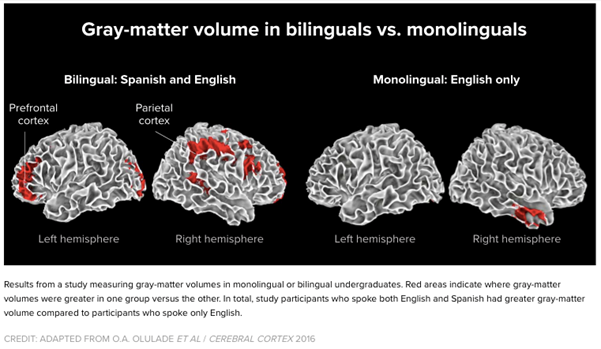
Executive function describes skills ‘that allow you to control, direct and manage your attention, as well as your ability to plan. It also helps you ignore irrelevant information and focus on what’s important.’[2] Key skills for STEM learning and later on, careers!
‘We are Thinkers’ one of the IB learner profiles isn’t just an abstract concept, but a true reflection of the state of our brain when learning an additional language!
2. Promoting flexible, interdisciplinary thinking
Language learning allows us to connect with others across differences, share knowledge and insights. It allows us to cross disciplinary boundaries and acquire new skills through an immersion in another culture, perspective and mode of expression. It builds our creativity and promotes interdisciplinary thinking. For a career in STEM, these skills are crucial: the ability to evaluate, analyse and consider complexities.
3. Enabling intercultural understanding
Language learning increases our intercultural competence. The ability to communicate with people from diverse cultures also encompasses an understanding of different perspectives and cultural codes.
In the globalised workplace, you will work with people from different cultural and linguistic backgrounds. You may also engage with diverse people on an everyday basis. Intercultural understanding is at the heart of global engagement promoted by the IB Diploma. Languages enable that connection while making us more understanding, empathetic and considerate of others’ perspectives.
Language brings us together, allows us to share our knowledge, feelings and insights with one another. It shapes our cultures and frames our perspectives. It also has the power to connect and inspire.
[1] Baker, Jordan, ‘NSW Students lag Australia and world in learning second language’ The Sydney Morning Herald, May 8, 2021 accessed 20 July
[2] Skibba, Ramin ‘How a second language can boost the brain’, Knowable Magazine published 11.29.2018 accessed 20 July, 2021