


What does civil engineering actually look like in the real world – and how do your STEM subjects connect to it?
As part of our Westbourne Business Connect Career Conversations, students heard from civil engineer Mark Dolan, General Manager at Christie Civil, a Sydney-based civil construction company that builds the infrastructure most of us never see but all of us rely on: stormwater drainage, wastewater networks, roads, bridges and major structures across Sydney.
“We build the infrastructure that keeps society moving,” Mark explained. “From stormwater and wastewater to roads and bridges – if it helps a city function, civil engineers are probably involved.”
When we asked how many students were interested in a career in engineering, a surprising number of hands went up – a clear sign that STEM pathways are front of mind for many Westbourne students.
Engineering: Turning Maths and Science into Real-World Impact
Early in his talk, Mark summed up civil engineering in a simple way:
“Engineering doesn’t just teach you how to build one thing – it gives you a framework to recognise a problem and work out how to solve it.”
For our students, the link to school subjects was obvious:
- Maths underpins calculations about forces, loads, angles and risks.
- Physics explains how structures move, vibrate and carry weight.
- Chemistry is essential for understanding materials such as concrete, steel and soil behaviour.
Mark stressed that the higher-level maths, physics and chemistry he studied in high school are still tools he uses every day – just applied to bigger, more complex problems with much higher stakes.
“Those skills I learned back in high school – I still use them today. The problems are bigger now, but the thinking is the same.”
He also broke down the typical engineering pathway on a project:
- Site Engineers use STEM knowledge to check that construction matches the design, supervise tests and collect data.
- Project Engineers plan ahead – scheduling materials, specialist equipment, testing and site activities.
- Project Managers and General Managers draw on years of technical experience to manage budgets, risk, safety and people.
For students imagining their future, it was a clear picture of how STEM learning evolves into leadership and responsibility over time.
A High-Stakes Sydney Project: Building Over the City’s Drinking Water
To show engineering in action, Mark described one of his most challenging projects: building a road and bridge over two huge pipelines that carry around 85% of Sydney’s drinking water from Warragamba Dam to Prospect Reservoir.
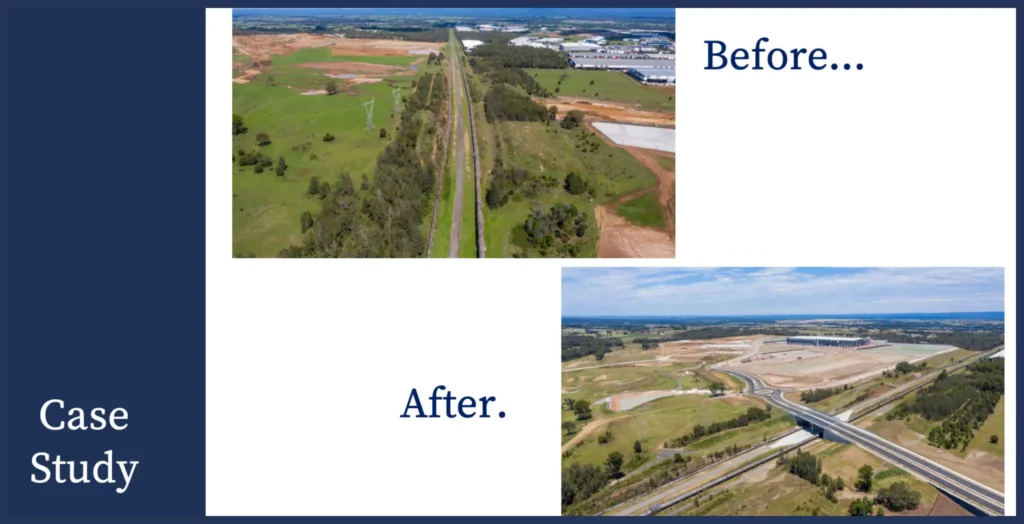
The project involved:
- Constructing a two-kilometre, four-lane road and bridge to connect a new Amazon automated distribution centre to the M7.
- Working only a few metres above pipelines around 3.5 metres in diameter – taller than a person.
- Delivering the project during the 2019–2020 drought, when Sydney’s water storage levels were under pressure.
- Coordinating with WaterNSW, geotechnical experts, piling and crane specialists to ensure absolute protection of the pipelines.
This was engineering at its most demanding: students heard how STEM skills were used to:
- Design safe working platforms for an 80-tonne piling rig drilling 25 metres into bedrock.
- Calculate whether bridge columns could safely support around 50 tonnes of wet concrete while it cured.
- Plan the delivery and installation of 35-metre-long, 70-tonne bridge beams using one of only a handful of 500-tonne cranes in the country.
- Communicate complex technical risks to non-engineers so that government authorities could be confident the project would not endanger Sydney’s water supply.
At several points, Mark returned to the idea of “trusting the numbers and the process” – you do the calculations, test your materials, plan meticulously, and then there’s a moment when the crane lifts or the rig drills and you must trust your STEM-based preparation.
“There’s a point where you’ve done the calculations, you’ve tested the materials, you’ve planned it out – and then you have to trust the numbers. That’s engineering.”
The project finished ahead of schedule and without incident – a powerful example of STEM turning into real-world impact on a city-wide scale.
What Happens When Things Don’t Go to Plan?
Students were curious about what happens when things go wrong on site.
Mark was honest: in civil construction, very few days run exactly as planned.
“I can’t remember a day where everything went perfectly,” he admitted with a smile. “Something always changes – the key is how you respond to it.”
Unexpected ground conditions, delayed deliveries, safety concerns or test results that don’t match expectations are all part of the job.
His key message was that engineers use the same STEM skills – analysis, logic, data – to solve problems under pressure, and that good planning, strong teams and clear communication are just as important as technical knowledge.
Advice for Future Engineers and Problem-Solvers
Mark closed with three pieces of advice that resonated strongly with our students:
- Stay curious and keep asking questions. Even with more than 20 years in the industry, he still learns something new every day. You don’t have to be the smartest person in the room – but you do need to be willing to listen and learn.
- Be open to your pathway changing. He initially imagined a career as a design engineer; real-world experience on construction sites led him into bridges, major infrastructure and management instead. Your STEM skills give you options – how you use them can evolve over time.
“I’d much rather try something and find out it’s not for me than be left wondering,” Mark told students.
- Don’t be afraid to make mistakes – just don’t make the same one twice. In engineering, not deciding is often worse than making a well-informed decision that needs adjusting. Collect the data, think logically, decide – and if something goes wrong, learn from it and share the learning.
“In construction, the worst thing you can do is not make a decision,” he said. “Get the information, make an informed call, and if something goes wrong, learn from it and make sure it doesn’t happen again.”

Why Career Conversations Matter at Westbourne
This Career Conversation with Christie Civil’s Mark Dolan brought the “why” behind STEM into sharp focus:
- It showed students how IB subjects like maths, physics and chemistry connect directly to real projects in Sydney.
- It highlighted the range of roles within engineering – from hands-on site work to high-level management.
- It reinforced that many Westbourne students are already seriously considering engineering and STEM careers.
This is exactly what Westbourne Business Connect is designed to do: connect our IB students with real professionals, real projects and real pathways into the future.
If your organisation is interested in supporting STEM and engineering career pathways through guest speaking, work experience or industry projects, please get in touch.